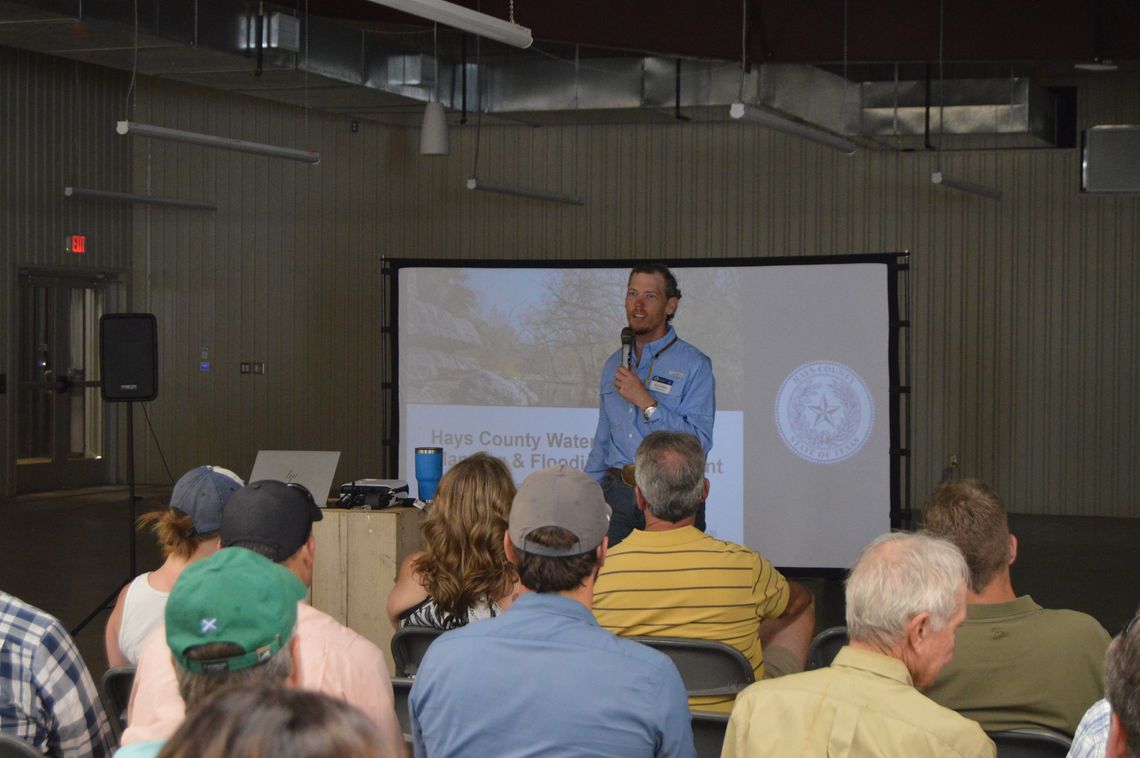
Hays County officials are gathering public input as work continues on a new countywide water study focused on long-term water availability, flooding concerns and wastewater infrastructure amid rapid growth across the region.
The study was approved by the Hays County Commissioners Court in January. It is the county’s first major water study since 2011 and is being conducted by HDR Engineering.
County officials say the study is meant to provide a clearer picture of how water moves through the county, where infrastructure gaps exist and what challenges may lie ahead.
According to the county, the study will examine water supply planning, wastewater management, flooding concerns and regulations that impact water use. The project also includes flood assessments in all four county precincts and a review of possible centralized sewer options in the Hillside Terrace neighborhood.
Last week, Hays County Precinct 4 Commissioner Walt Smith hosted one of several public stakeholder meetings connected to the study. Smith said the meetings are designed to gather local information from residents, water providers and environmental groups while HDR remains in the data collection phase.
Smith said the county’s previous water study is now outdated because of major growth and development over the past decade.
Precinct 3 Commissioner Morgan Hammer said West Hays County has faced water challenges for years.
“There have always been challenges in West Hays County,” Hammer said. “There are so many factors at play, and every part of the county is different, so this study will help us clearly see what’s really going on.”
Smith said county leaders expanded the study beyond water supply concerns to also include flooding and wastewater issues.
“We are really trying to take a look at where the water is coming from, where it’s being used, what the sources of that water are, what impact it has, especially in flood situations,” Smith said. “And then what happens to it once it’s been used within the system?”
Smith said county officials also hope the study will provide data that can support future discussions with state lawmakers about local planning and development authority.
A wide range of groups were invited to participate in the meetings, including groundwater districts, watershed associations, environmental organizations, regional planning groups and licensed water system operators.
He said many residents may not realize how many licensed public water systems exist in the county.
“For example, in my precinct, there’s roughly 140 licensed public water systems,” Smith said.
Smith said even some small businesses can qualify as public water systems under state regulations. He pointed to a gas station at the corner of Nutty Brown Road and FM 1826 as an example. Because the business serves food while operating on a well, it must be licensed and regularly test its water supply.
Smith said public meetings are important because residents often know about local flooding or infrastructure problems that may not appear in maps or official data.
“There are things, especially when we look at the flood portion of the study, that only local residents with knowledge of the area would know,” Smith said.
Smith said residents have already shared concerns about low-water crossings, flood-prone areas and water systems dealing with well failures or enhanced monitoring by the Texas Commission on Environmental Quality.
County officials said the study is expected to take about 11 months to complete and will cost no more than $542,360.
Smith said the county is currently focused on gathering information and conducting stakeholder interviews.
“We’re collecting the paint right now,” Smith said. “We’re trying to get all the input that we can, and then once we get that and the data is analyzed, that’s where you paint the picture of what’s actually on the ground here in Hays County.”
Additional public meetings are expected as the study moves forward. He also said county leaders want the final report to remain an active planning tool rather than a one-time study.
“This is not a study that should be put on a shelf,” Smith said. “The county itself and the commissioners court must use this data in the most effective way possible.”