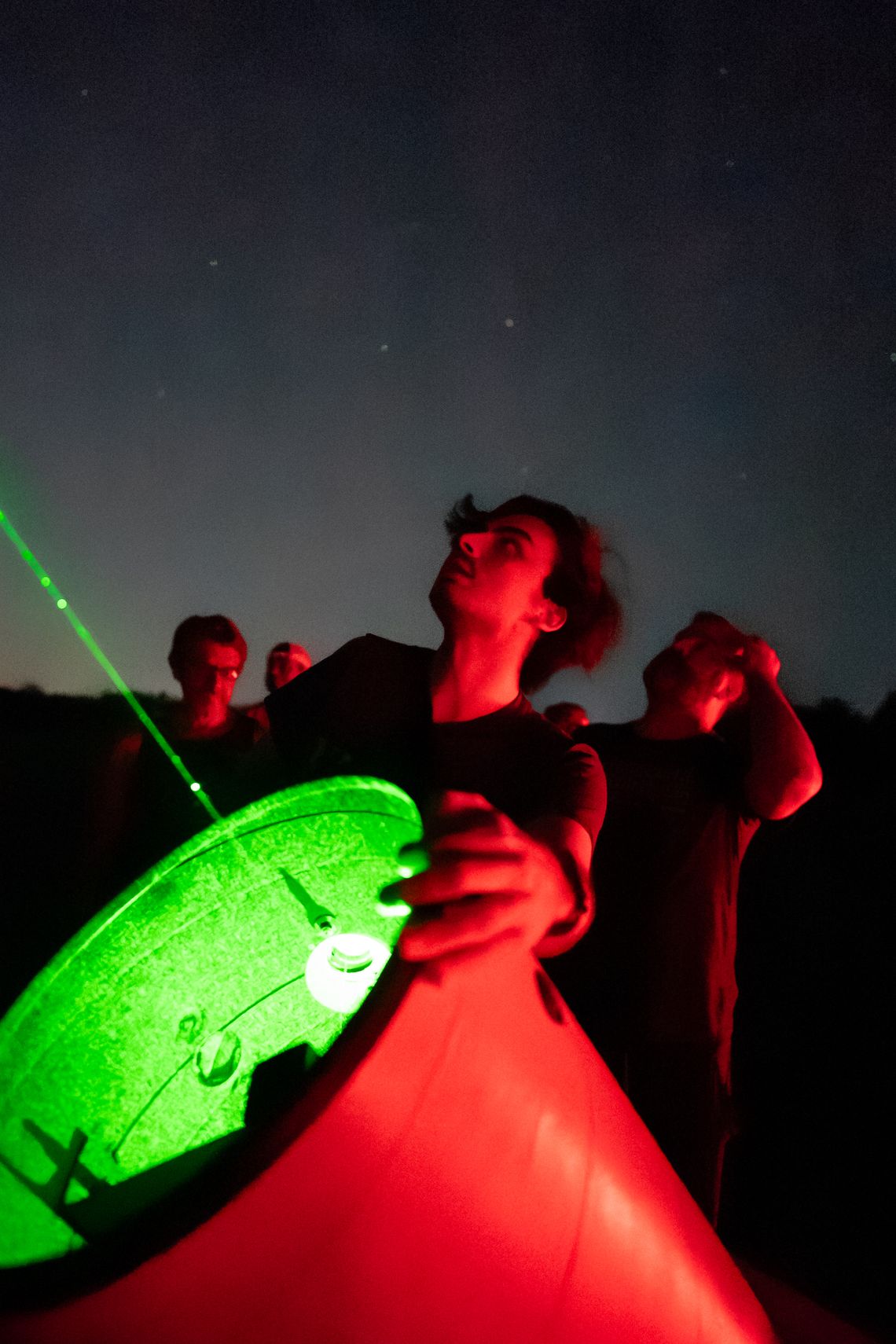
Aiming for Earth’s celestial neighbors at a Blue Hole Star Party. Photo by Matthew Hartmann.
It’s Dark Sky Week in both the Wimberley Valley and on the world stage with International Dark Sky Week, April 13 to 20. Blue Hole Regional Park and Wimberley Valley Dark Sky are holding a Star party this Saturday, April 18, starting at 7:30 p.m., between the soccer and basketball courts on the Blue Hole loop drive. The party kicks-off with live music by The Schubert Brothers, Will and Jim, who play a mix of bluegrass, folk, blues and acoustic country. As soon as the sky darkens, around 8:30 p.m., star and planet viewing will begin. Most telescopes are supplied by members of the Astronomy Club at Texas State University. Individuals may bring telescopes, as long as they are able to operate them and are willing to share them with others. Attendees are encouraged to come early with blankets, picnics and games to relax and hear the live music. As always, a star party is weather dependent; in case of rain or heavy overcast, the party will be rescheduled. There is no fee to attend. Respect for the darkness of the night sky is an important ideal in the Wimberley Valley. The Wimberley Valley was officially recognized as an International Dark Sky Community in 2018 by DarkSky, previously The International Dark-Sky Association. It was the second Texas community, after Dripping Springs, so designated; today, as night sky awareness grows, there are nine Texas communities and a total of 23 Dark Sky Places, counting parks, reserves, sanctuaries and Urban Night Sky Places. For more information, go to darksky.org and select “What We Do.” Residents are encouraged to keep Wimberley Valley skies dark. Consider five questions from DarkSky International about the outdoor lighting around your home: Is it useful? All light should have a clear purpose. Is it targeted? Shield or aim light so it falls downward, where it is useful. Is it low-level? Light should be no brighter than necessary. Is it controlled? Use time and motion sensors to turn lights on/off only when needed. Is it warm-(amber)-colored? Light in the 2700K-3000K (Kelvin) range has many benefits, including less skyglow than higher Kelvin (bluer) light.
PLEASE LOG IN FOR PREMIUM CONTENT. Our website requires visitors to log in to view the best local news.
Not yet a subscriber? Subscribe today!